

What Is a Good ROAS? How to Evaluate Advertising Performance Beyond Revenue

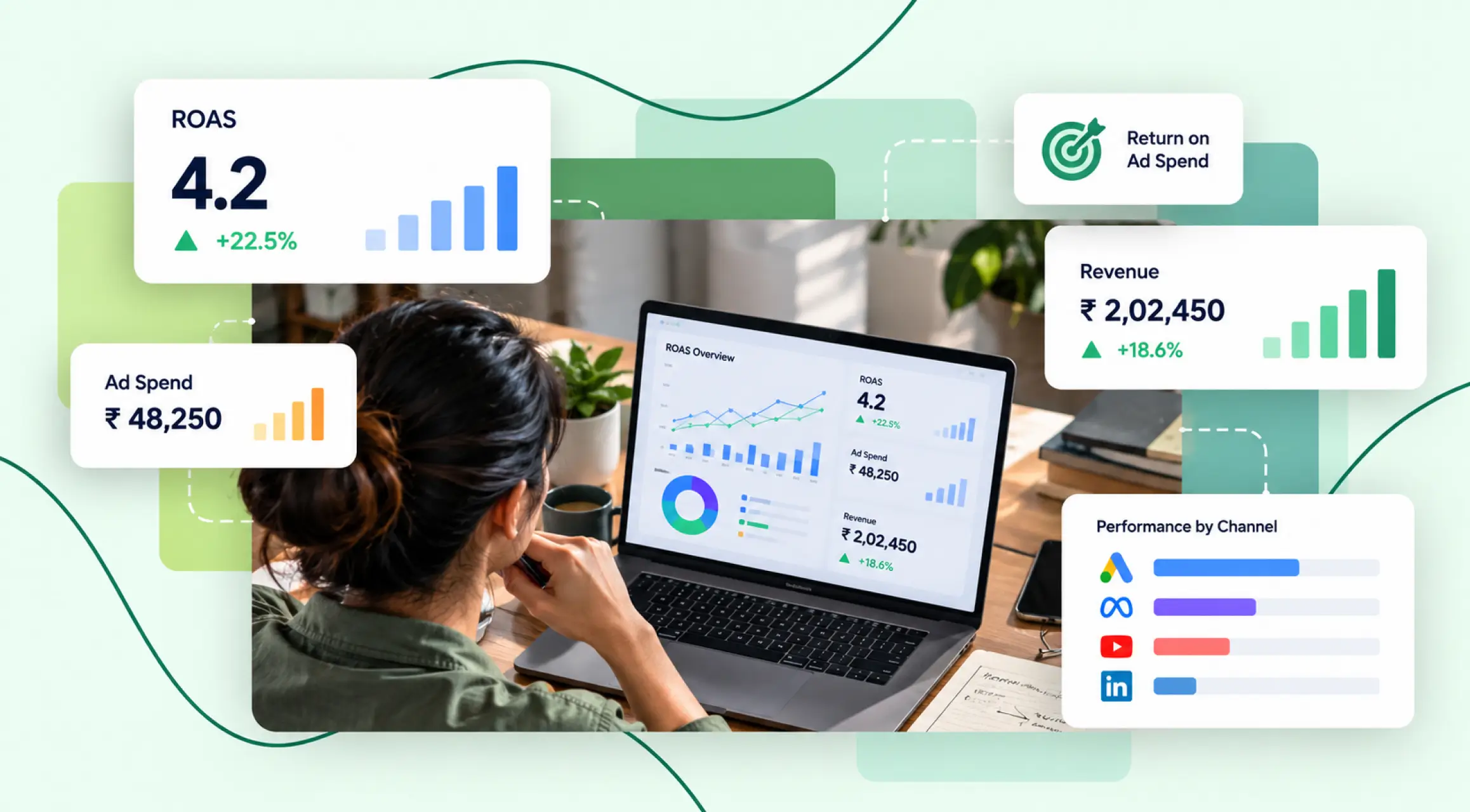
Running ads is one thing. Knowing whether those ads are actually helping your business grow is another.
You might spend ₹20,000 on Google Ads or Meta Ads and generate ₹1,00,000 in revenue. That sounds like a great result. But what if your product costs, shipping, discounts, and other expenses leave you with very little profit?
This is why looking at revenue alone can be misleading.
ROAS (Return on Ad Spend) helps businesses understand how much revenue their advertising generates. However, to evaluate advertising performance properly, you also need to consider profitability, customer acquisition costs, lead quality, and long-term customer value.
In this blog, we’ll explain what a good ROAS looks like, how to calculate it, and which other metrics help you understand whether your advertising is delivering meaningful business results.
What Is ROAS?
ROAS stands for Return on Ad Spend. It measures how much revenue you generate for every rupee spent on advertising.
The formula is simple:
ROAS = Revenue Generated from Ads ÷ Advertising Spend
For example, imagine your business spends ₹20,000 on an advertising campaign and generates ₹1,00,000 in revenue.
Your ROAS would be:
₹1,00,000 ÷ ₹20,000 = 5x ROAS
This means you generated ₹5 in revenue for every ₹1 spent on ads.
Here’s how different advertising results compare:
A higher ROAS generally indicates stronger revenue returns relative to advertising spend. However, it doesn't automatically mean your business is profitable.
To understand why, let's look at what makes a ROAS good or bad.
What Is a Good ROAS?
Many businesses aim for a ROAS of 3x, 4x, or even 5x. But there is no single number that guarantees success for every business.
A good ROAS depends on your profit margins, industry, product pricing, customer acquisition costs, and business goals.
For example, an e-commerce brand selling low-margin products may need a higher ROAS to cover its expenses. A business selling high-margin products might remain profitable at a lower ROAS.
Consider these examples:
- 1x ROAS: You generate ₹1 in revenue for every ₹1 spent on ads. Your advertising spend equals the revenue generated, before other costs.
- 2x ROAS: You generate ₹2 for every ₹1 spent. Whether this is profitable depends on your margins.
- 3x ROAS: You generate ₹3 for every ₹1 spent. This could be a healthy result for some businesses.
- 5x ROAS: You generate ₹5 for every ₹1 spent. This may be a strong result, but your other costs still matter.
Instead of chasing a specific number, ask yourself three questions:
- Does the campaign cover its advertising and operating costs?
- Are we acquiring the right customers at a reasonable cost?
- Can we increase the budget without reducing performance significantly?
The answers will tell you more about campaign success than ROAS alone.
Break-Even ROAS: Know the Minimum Return You Need
Before setting a ROAS target, you should understand your break-even ROAS.
Break-even ROAS is the minimum advertising return required to cover the costs associated with the sales generated.
For a simple example, suppose your business has a 40% contribution margin before advertising. This means ₹40 from every ₹100 in sales is available to cover advertising and other expenses not already deducted.
Your break-even ROAS is:
Break-Even ROAS = 1 ÷ Contribution Margin
In this case:
1 ÷ 0.40 = 2.5x
Your campaign needs to generate ₹2.50 in revenue for every ₹1 spent on advertising to reach the break-even point under these assumptions.
Here is how contribution margins affect break-even ROAS:
These figures are simplified estimates. Your calculation should account for the costs included in your margin, such as product costs, fulfilment, payment fees, and discounts, as applicable.
Break-even ROAS is a starting point, not your final target. Your business may also need to cover salaries, software, rent, taxes, and other overheads before it can generate an overall profit.
ROAS vs ROI: What Is the Difference?
ROAS and ROI are often used interchangeably, but they measure different things.
For example, a campaign that spends ₹10,000 and generates ₹40,000 in revenue has a 4x ROAS.
However, if the product, fulfilment, advertising, and other relevant costs total ₹35,000, the remaining amount is only ₹5,000 before any additional costs not included in that figure.
This illustrates why a strong ROAS doesn't necessarily translate into an equally strong profit.
Use ROAS to understand how efficiently your ads generate revenue. Use an appropriately calculated ROI or profitability measure to assess the broader financial return.
Is ROAS Different for Google Ads and Meta Ads?
Yes. Google Ads and Meta Ads often play different roles in the customer journey, so their results should be evaluated in context.
Google Ads: Capturing Existing Demand
Google Search Ads often reach people who are already searching for a product or service.
For example, someone searching for “interior designers in Ahmedabad” may already be looking for a professional to hire.
Google Ads can be particularly useful for capturing high-intent demand, although results depend on keywords, competition, landing pages, and the offer.
Meta Ads: Building Interest and Generating Demand
Meta Ads on platforms such as Instagram and Facebook can help businesses reach relevant audiences, introduce products, build interest, and encourage purchases.
For example, a skincare brand may use Instagram ads to introduce a new cleanser to people who have not previously heard of the brand.
Some users may purchase immediately, while others may need multiple interactions before converting.
How Should You Compare Them?
Avoid judging both platforms using ROAS alone. Consider the purpose of each campaign, its audience, conversion window, and contribution to the customer journey.
Also, remember that advertising platforms may attribute the same conversion differently. Their reported ROAS figures may not be directly comparable.
Use consistent tracking through tools such as GA4 and your CRM or e-commerce platform, where appropriate, to develop a clearer view of overall performance.
Why Is Your ROAS Low?
If your campaigns are generating less revenue than expected, the problem may not be your advertising budget alone.
Here are some common reasons:
- Wrong audience targeting: Your ads may be reaching people who are unlikely to purchase or enquire.
- Weak creative or messaging: If your ads don't communicate a clear benefit, people may scroll past them without engaging.
- Poor landing page experience: Slow-loading pages, unclear information, weak calls to action, or complicated checkout processes can reduce conversions.
- Uncompetitive pricing or offers: Customers may choose competitors if your product, pricing, or value proposition doesn't meet their expectations.
- Incorrect tracking: Missing conversion events or inconsistent attribution can make campaign performance appear better or worse than it actually is.
- Limited remarketing: People who have already shown interest may need additional information or reminders before making a decision.
- Unrealistic expectations: New campaigns may require testing and optimisation before performance becomes consistent.
Instead of increasing the budget immediately, identify where potential customers are dropping off and address the underlying issue.
How to Improve ROAS Without Simply Increasing Your Budget
Improving ROAS requires a combination of better targeting, stronger creative, conversion optimisation, and reliable measurement.
Here are six practical ways to get started.
1. Focus on High-Intent Audiences
Use relevant keywords, audience signals, customer data, and campaign segmentation to reach people who are more likely to convert.
For Google Ads, review search terms and exclude irrelevant queries. For Meta Ads, test suitable audience strategies and creative variations.
2. Test Different Ad Creatives
Your creative can influence whether people notice, understand, and respond to your offer.
Test different hooks, visuals, product demonstrations, benefits, and calls to action. Evaluate the results against meaningful conversion metrics rather than engagement alone.
3. Improve Your Landing Pages
Your ads may attract the right audience, but a confusing website can prevent conversions.
Ensure that your landing page communicates the offer clearly, loads quickly, works well on mobile devices, and makes the next step easy.
Professional website design services and conversion rate optimisation can help create a smoother path from click to conversion.
4. Review Your Campaign Data Regularly
Look beyond the overall ROAS figure.
Analyse performance by campaign, audience, keyword, creative, device, and landing page wherever reliable data is available.
This helps identify which areas deserve more investment and which need improvement.
5. Retarget Interested Audiences
Depending on your business and privacy requirements, retarget people who visited your website, engaged with your content, or abandoned their cart.
Provide useful reminders, answer common objections, and highlight relevant product benefits rather than repeatedly showing the same ad.
6. Optimise for Business Outcomes
Don't optimise every campaign for the cheapest click or the highest number of leads.
Where tracking and conversion volume support it, use meaningful conversion events and assess the quality of the results. For lead generation, connect advertising data with qualified leads and actual sales whenever possible.
A campaign that generates fewer but better-quality leads may be more valuable than one that produces a high volume of irrelevant enquiries.
8. When Should You Increase Your Advertising Budget?
A campaign with a good ROAS may appear ready for scaling, but increasing the budget too quickly can change its performance.
Before scaling, check whether:
- The campaign has delivered reasonably consistent results over a meaningful period.
- Conversion tracking is accurate.
- The leads or customers generated are relevant.
- Your margins support the acquisition cost.
- Your business can handle the additional orders or enquiries.
- You have enough budget to test and optimise without putting overall profitability at risk.
Increase spending in a controlled way and monitor how the results change.
Remember that a campaign performing well at ₹10,000 per month may not maintain the same ROAS at ₹1,00,000. As spending grows, you may reach new audiences, face greater competition, or experience changes in conversion efficiency.
Scale based on sustainable business results, not just an attractive ROAS number.
9. How TYT Studio Helps Businesses Evaluate Advertising Performance
At TYT Studio, we believe effective advertising is about more than generating clicks, impressions, or revenue. It is about understanding how marketing contributes to business growth.
Our approach combines creative thinking, data analysis, and performance-focused execution to help businesses make more informed marketing decisions.
Through our performance marketing services, we help businesses plan, manage, and optimise campaigns across Google Ads and Meta Ads based on their objectives.
Our wider digital marketing services can also support campaign performance through:
- Search engine optimization: Improve organic visibility and attract relevant visitors over time.
- Social media marketing services: Build brand awareness, engage relevant audiences, and support demand generation.
- Website design services: Create user-friendly digital experiences that help visitors take the next step.
- Graphic and branding services: Develop consistent, compelling brand communication across advertising and digital channels.
- Analytics and conversion tracking: Understand campaign results and identify opportunities for improvement.
Every business has different margins, audiences, and growth objectives. That's why the right advertising strategy begins with understanding your business, defining meaningful KPIs, and evaluating performance beyond a single metric.
Final Thoughts
A good ROAS is not simply the highest number you can achieve. It is a return that supports your business goals, covers the relevant costs, and creates opportunities for sustainable growth.
Use ROAS to understand advertising revenue efficiency, but look at customer acquisition cost, conversion rates, lead quality, customer lifetime value, and profitability to get the complete picture.
When you understand how these metrics work together, you can make smarter decisions about your campaigns, spend your budget more effectively, and focus on results that matter to your business.
Frequently Asked Questions (FAQs)
In today's competitive digital landscape, businesses need more than advertisements to attract potential customers. They need to reach the right audience, communicate their value, and turn...

Imagine a potential customer asking an AI tool, “Which digital marketing agency can help my business generate more leads?” Instead of browsing dozens of websites immediately, they may receive a...
Every business wants more website traffic, but traffic alone does not guarantee enquiries, sales, or business growth. A website may attract hundreds of visitors through search engines, yet...
Just one more step to make your perfect choice. Book a demo today.


