

Rebranding vs. Brand Refresh: How to Know Which One Your Business Needs

A brand is more than a logo, colour palette, or tagline. It represents how people recognise your business, what they expect from it, and why they choose it over competitors. But as businesses grow, customer expectations change, and markets become more competitive, a brand that once worked well may no longer reflect where the business is heading.
This is where two options come into the picture: rebranding and brand refresh.
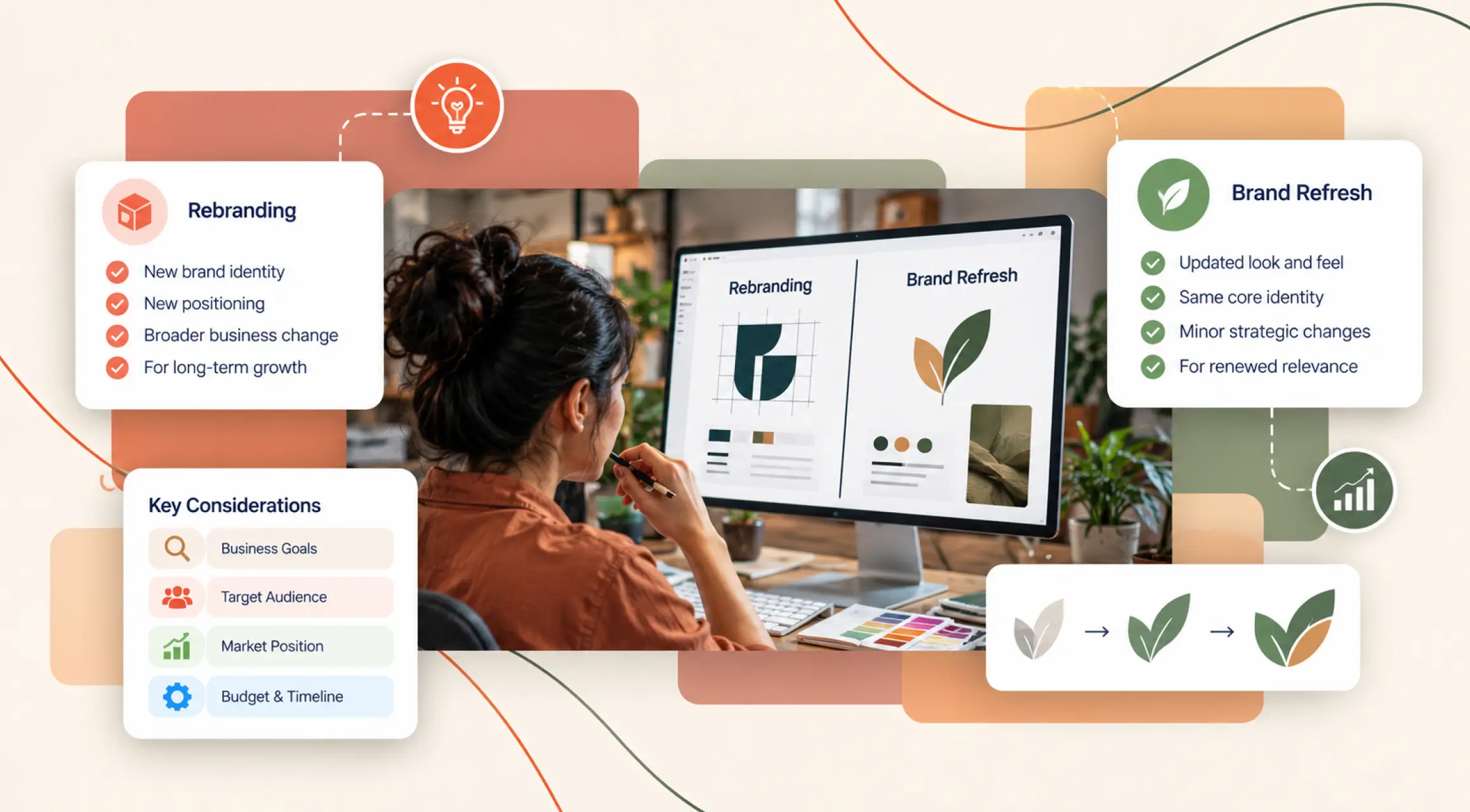
Although these terms are often used interchangeably, they serve different purposes. A brand refresh improves what already exists, while rebranding involves a more fundamental change in how a business presents and positions itself.
Understanding the difference can help you decide where to invest your time, money, and creative resources.
The Difference Between Rebranding and a Brand Refresh
Think of your brand as the personality of your business. Sometimes, it needs a little refinement. At other times, it needs a completely new direction.
| Factor | Brand Refresh | Rebranding |
|---|---|---|
| Main purpose | Modernise the existing brand | Establish a new brand identity or direction |
| Visual identity | Updates colours, typography, logo details, or layouts | May introduce a completely new logo, visual language, and identity |
| Brand messaging | Refines existing communication | May redefine the mission, values, positioning, and messaging |
| Target audience | Usually remains similar | May expand or change significantly |
| Brand recognition | Preserves existing recognition | May require rebuilding recognition |
| Business impact | Typically more limited | Often involves wider organisational and marketing changes |
The key distinction: A refresh evolves your existing identity, whereas rebranding changes how your business wants to be perceived.
Neither approach is automatically better. The right choice depends on the problem your business is trying to solve.
Five Signs Your Business May Need a Brand Refresh
A brand refresh is often the right choice when your business has a strong foundation, but its presentation needs improvement.
Sign 1: Your visual identity looks outdated
Your logo, typography, website, or social media creatives may no longer reflect current design standards or your business's quality. A thoughtful update can make the brand feel more relevant without losing its identity.
Sign 2: Your business has grown, but your branding hasn't
Perhaps you started with a small product range and now serve a much wider market. Your brand may need a more polished visual system to reflect that progress.
Sign 3: Your communication lacks consistency
Different colours, writing styles, layouts, and messages across platforms can make your business appear disconnected. A refresh can establish consistent brand guidelines for your website, social media, advertisements, and other touchpoints.
Sign 4: Your website no longer represents your business
A confusing user journey, outdated layouts, or inconsistent messaging can affect how customers perceive your brand. Updated website design, clearer content, and improved navigation can help create a more cohesive experience.
Sign 5: You want to remain recognisable while looking more current
If customers already recognise and trust your business, retaining familiar brand elements can help preserve that connection while improving the overall presentation.
When Is Rebranding the Better Decision?
Sometimes, updating your logo or changing your website colours will not address the real issue. Your business may have outgrown its original identity or moved in a completely different direction.
Consider rebranding when:
- Your business model has changed: You have expanded from a single service into multiple offerings or entered a new industry.
- Your target audience has shifted: Your messaging and positioning no longer connect with the customers you want to reach.
- Your brand lacks differentiation: Competitors look and sound similar, making it difficult for customers to understand what makes your business different.
- Your reputation needs a new direction: Your existing identity no longer reflects the values, quality, or experience you want to communicate.
- Your business is undergoing a major transformation: A merger, acquisition, expansion, or strategic repositioning may require a new brand identity.
Rebranding should address a meaningful business challenge rather than simply follow a design trend. It requires clarity about what the business stands for, whom it serves, and how it wants to be positioned in the market.
A Quick Brand Health Check: Which Direction Should You Take?
Before investing in a brand refresh or a complete rebrand, ask yourself these questions.
Question 1: Do customers still recognise and trust your brand?
If yes, preserving familiar elements through a refresh may make sense.
Question 2: Does your brand communicate your current products, services, and business values?
If the answer is no because of outdated visuals, messaging, or website design, a refresh could help. If the business itself has fundamentally changed, rebranding may be more appropriate.
Question 3: Are you struggling with presentation or positioning?
Presentation problems often call for a refresh. Positioning problems may require deeper brand strategy and potentially a rebrand.
Question 4: Are you attracting the right audience?
If your brand consistently attracts the wrong customers, review your messaging, audience targeting, pricing communication, and market positioning before deciding on a visual change.
Question 5: What do you want to achieve?
Define the intended outcome first, whether that is improved recognition, stronger differentiation, better customer engagement, or entry into a new market.
Your answers should guide the decision instead of personal preferences about colours, fonts, or logo styles.
The Process: How to Refresh or Rebrand Strategically
A successful brand transformation begins with research, not design.
Step 1: Audit Your Existing Brand
Review your logo, website, social media profiles, advertisements, messaging, customer feedback, and competitor positioning. Identify what works, what feels outdated, and what creates confusion.
Step 2: Understand Your Audience
Study your customers' needs, expectations, buying behaviour, and perceptions of your business. A brand should resonate with the people it serves rather than simply reflect the preferences of its internal team.
Step 3: Define Your Brand Direction
Establish your positioning, value proposition, personality, and communication style. If the fundamentals remain relevant, a refresh may be sufficient. If they need substantial change, consider rebranding.
Step 4: Update Your Brand Assets
Depending on your chosen approach, this may involve refining your logo, establishing visual guidelines, improving website design, updating social media templates, and developing consistent marketing materials.
Step 5: Align Your Digital Presence
Your brand should communicate consistently across search results, your website, social media, paid campaigns, email, and other customer touchpoints. Update relevant assets and messaging together rather than treating each platform as a separate project.
Step 6: Measure the Impact
Monitor brand awareness, website engagement, qualified enquiries, conversion rates, customer feedback, and other relevant indicators. Compare performance against your baseline to understand whether the changes are achieving their intended goals.
Common Mistakes Businesses Should Avoid
Even a well-designed brand can struggle if the process lacks strategic direction.
- Changing everything without a clear reason: A visual overhaul will not automatically solve weak positioning or poor customer experience.
- Ignoring existing brand equity: Familiar elements may hold valuable recognition and trust that should not be discarded without careful consideration.
- Following trends blindly: Design choices should support your brand's personality and audience, not simply imitate competitors.
- Updating visuals without fixing the website experience: Branding and website design should work together to create a clear, consistent customer journey.
- Launching without a communication plan: Employees, existing customers, partners, and prospects should understand important changes where relevant.
- Failing to measure outcomes: Without defined goals, it becomes difficult to determine whether the refresh or rebrand has delivered value.
How Digital Marketing Supports a Stronger Brand
Branding does not stop when the new logo or website goes live. Your digital presence plays an important role in reinforcing your identity and helping customers discover your business.
A well-planned strategy can bring together several essential services:
- Search Engine Optimization: Search engine optimization helps improve your website's visibility for relevant search queries and supports long-term organic discovery.
- Social Media Marketing Services: Consistent content, creative storytelling, and community engagement help communicate your brand personality and build audience relationships.
- Performance Marketing Services: Paid campaigns can help introduce your updated positioning to relevant audiences, generate enquiries, and measure campaign outcomes.
- Website Design: A user-focused website helps translate your brand identity into a consistent digital experience through clear messaging, intuitive navigation, and relevant calls to action.
- Digital Marketing Services: Coordinated marketing across relevant channels helps maintain consistency between what your brand promises and what customers experience.
When evaluating the best digital marketing services for your business, look beyond individual deliverables. Consider how well the strategy connects your brand identity, audience needs, digital channels, and measurable business objectives.
Final Thoughts: Evolve Your Brand with a Clear Purpose
A brand refresh and a rebrand can both help businesses stay relevant, but the decision should begin with understanding what needs to change.
If your brand has a strong identity but needs a more modern, consistent presentation, a refresh may be the practical choice. If your audience, positioning, business model, or long-term direction has changed significantly, rebranding may offer a more suitable path.
The goal is not to change your brand simply to look different. It is to build an identity that accurately represents your business, connects with your audience, and supports your future growth.
How TYT Studio Can Help
TYT Studio is an Ahmedabad-based digital marketing and design agency that helps businesses strengthen their digital presence through strategic thinking, creative communication, and performance-focused execution.
From brand identity and website design to search engine optimization, social media marketing services, and performance marketing services, TYT Studio brings together the creative and digital elements that help businesses communicate consistently across customer touchpoints.
Whether your business needs a brand refresh or a more comprehensive repositioning, the focus is on understanding your goals, identifying opportunities, and developing a strategy aligned with your audience and growth plans.
Looking to build a stronger brand? Connect with TYT Studio to explore the right branding and digital marketing approach for your business.
Frequently Asked Questions

Growing a business on social media takes more than simply posting content or running advertisements. Brands need to build awareness, earn audience trust, and turn interest into meaningful...

Running ads is one thing. Knowing whether those ads are actually helping your business grow is another. You might spend ₹20,000 on Google Ads or Meta Ads and generate ₹1,00,000 in revenue. That...
In today's competitive digital landscape, businesses need more than advertisements to attract potential customers. They need to reach the right audience, communicate their value, and turn...
Just one more step to make your perfect choice. Book a demo today.


