

How to Build a Digital Customer Journey From First Click to Repeat Purchase

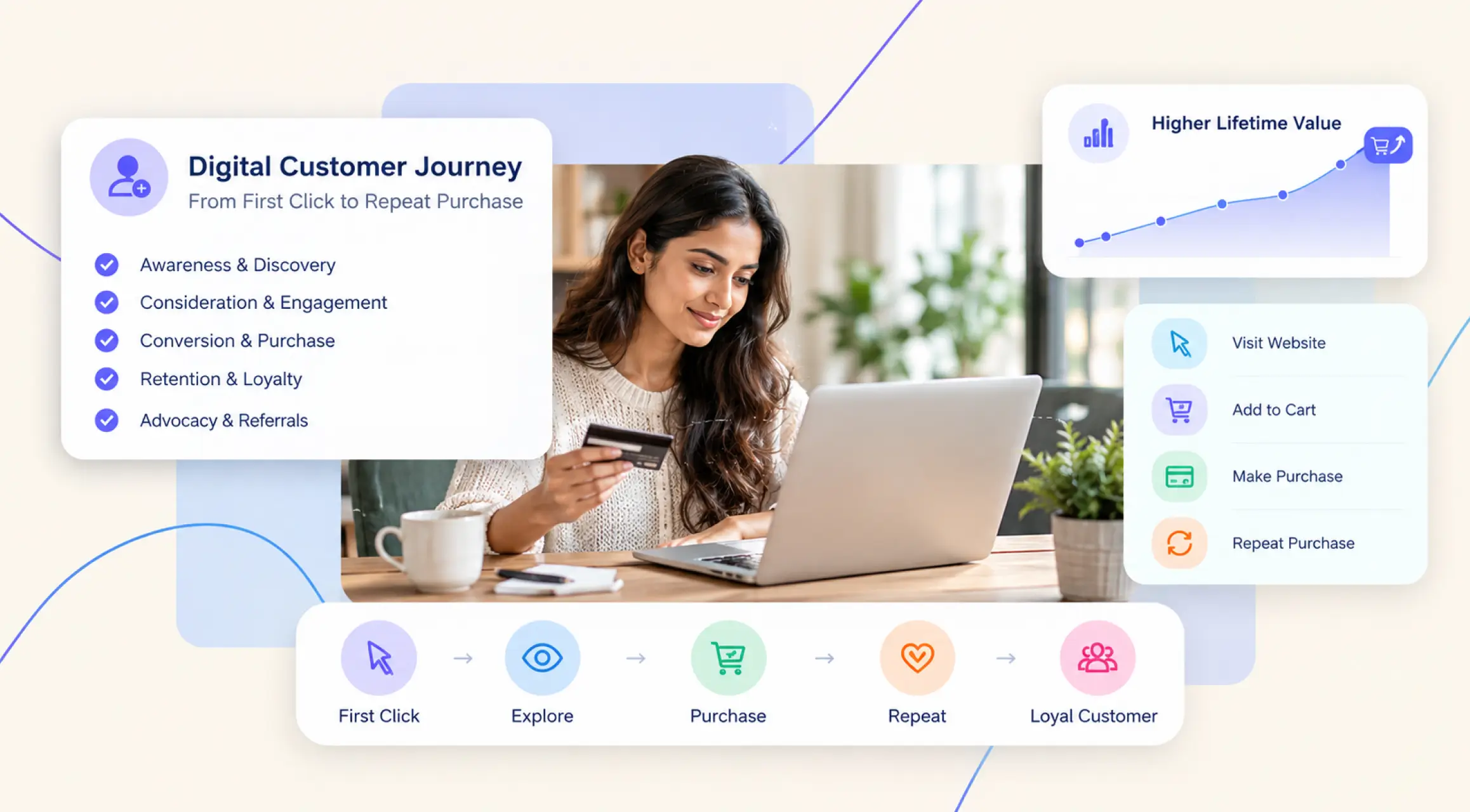
In digital marketing, a customer's decision to purchase is rarely influenced by a single interaction. Before choosing a brand, customers typically go through several stages of online research, information gathering, comparison, and evaluation.
For example, someone looking for a skincare product might first discover a brand through Instagram, search for its ingredients on Google, visit the website to understand the product benefits, read customer reviews, and eventually place an order. Their experience after purchasing may determine whether they buy from the same brand again.
This entire process is known as the digital customer journey.
A digital customer journey represents the different stages and touchpoints through which a potential customer interacts with a business, from initial awareness to purchase and post-purchase engagement.
Understanding this journey helps businesses identify customer expectations, improve marketing communication, reduce conversion barriers, and develop strategies that encourage long-term relationships.
Let's explore how each stage works and what businesses can do to optimise it.
Customer Awareness: How People Discover a Brand
The awareness stage marks the beginning of the customer journey. At this point, people become familiar with a business, product, or service, often while searching for solutions to a particular need.
Brand discovery can happen through several digital channels, including:
- Organic Google search results.
- Social media platforms such as Instagram, Facebook, and LinkedIn.
- Paid search and display advertisements.
- YouTube videos and online publications.
- Influencer recommendations and customer referrals.
- Educational blogs and industry-related content.
The choice of channel depends on the target audience, industry, and nature of the offering.
For instance, a B2B manufacturing company may receive relevant traffic through Google searches and LinkedIn, while a fashion or skincare brand may generate discovery through Instagram, influencer content, and shopping advertisements.
How businesses can optimise this stage:
- Identify relevant audience segments and their search behaviour.
- Research keywords related to products, services, and customer problems.
- Develop educational and industry-specific content.
- Maintain consistent brand communication across relevant platforms.
- Use search engine optimization to improve organic visibility.
- Run targeted awareness campaigns to reach new audiences.
The objective is to ensure that potential customers can discover the business when they are searching for relevant information or exploring available solutions.
Interest and Engagement: Encouraging Customers to Explore Further
After discovering a brand, customers generally look for additional information before deciding whether it is relevant to their needs.
They may visit the website, explore social media profiles, watch product demonstrations, read blogs, or interact with advertisements.
At this stage, the quality and relevance of brand communication become important.
Businesses should provide content that explains their offerings, addresses customer questions, and communicates their expertise.
For example:
- An educational blog can explain how a particular product works.
- A product demonstration can highlight features and applications.
- A social media post can address frequently asked customer questions.
- A case study can demonstrate how a business solved a client's problem.
- An explainer video can simplify a complex service or process.
Social media marketing services support this stage through content planning, audience engagement, community management, and consistent brand communication.
Important consideration: Engagement should not be measured only through likes and followers. Website visits, content saves, meaningful enquiries, video completion rates, and returning visitors can provide additional insights into audience interest.
The purpose of this stage is to move customers from simply knowing about a brand to actively exploring what it offers.
Consideration: How Customers Evaluate Their Options
The consideration stage is where potential customers begin comparing different brands and evaluating which option best meets their requirements.
Their decisions may depend on several factors:
- Product or service quality.
- Pricing and overall value.
- Features and specifications.
- Brand reputation and credibility.
- Customer reviews and testimonials.
- Availability and convenience.
- Customer support and service standards.
For businesses, this stage requires clear and accessible information.
A potential customer should be able to understand what makes the offering relevant, how it addresses their needs, and what differentiates it from alternatives.
Strategies to strengthen customer consideration:
- Publish detailed information: Provide accurate product descriptions, service details, specifications, pricing, and relevant usage information.
- Build credibility: Display genuine reviews, testimonials, certifications, and relevant business credentials.
- Use case studies: Demonstrate practical applications and measurable outcomes wherever possible.
- Address common objections: Create FAQs and educational resources that answer questions customers commonly ask before purchasing.
- Improve website navigation: Make it easy for visitors to explore relevant pages and find essential information.
A strong consideration strategy reduces uncertainty and gives customers the information required to make informed decisions.
Conversion: Turning Customer Interest Into Action
Conversion occurs when a potential customer completes a desired action. Depending on the business, this could be an online purchase, enquiry submission, appointment booking, consultation request, or product registration.
However, customer interest does not always translate into conversion.
Several factors can interrupt the process, including:
- Slow website loading.
- Complicated navigation.
- Unclear product or service information.
- Lengthy enquiry or checkout forms.
- Unexpected costs.
- Limited payment options.
- Lack of trust indicators.
Businesses need to identify and remove these barriers to make the conversion process easier.
Ways to improve conversion rates:
- Create clear calls to action that explain the next step.
- Optimise landing pages according to campaign objectives.
- Ensure mobile responsiveness and fast-loading pages.
- Simplify checkout and enquiry processes.
- Display customer reviews and relevant trust signals.
- Use remarketing to reconnect with interested visitors.
- Track conversions to identify effective marketing channels.
Website design services contribute to this process by improving website usability, information structure, visual communication, and user experience.
Meanwhile, performance marketing services help businesses reach relevant audiences through targeted campaigns, remarketing, conversion tracking, and ongoing campaign optimisation.
The objective is to turn relevant website traffic and customer interest into measurable business outcomes.
Post-Purchase Experience: What Happens After Conversion?
The customer journey continues after the transaction is completed.
The post-purchase stage includes all interactions a customer has with a business after buying a product or using a service. This experience can influence customer satisfaction, brand trust, future purchases, and recommendations.
For e-commerce businesses, post-purchase communication may include:
- Order confirmation and payment receipts.
- Shipping and delivery updates.
- Product usage instructions.
- Customer support and return assistance.
- Feedback and review requests.
- Relevant product recommendations.
For service-based businesses, it may involve project updates, service delivery communication, onboarding assistance, and follow-up consultations.
A structured post-purchase process helps customers understand what to expect and where to seek assistance if required.
Businesses should also monitor customer complaints, product-related concerns, delivery issues, and service feedback to identify areas that need improvement.
Why this stage matters: A positive experience after purchasing helps establish confidence in the business and creates opportunities for future engagement.
Customer Retention: Increasing the Value of Existing Relationships
Customer retention refers to a business's ability to maintain relationships with existing customers over a specific period.
While customer acquisition focuses on attracting new buyers, retention focuses on encouraging existing customers to continue engaging with the brand.
A well-planned retention strategy can help businesses generate repeat revenue, improve customer lifetime value, and reduce dependence on continuous new customer acquisition.
Some commonly used retention methods include:
- Email marketing: Send relevant updates, educational information, product announcements, and personalised offers.
- WhatsApp communication: Share order updates, service reminders, product information, and customer support messages with appropriate consent.
- Loyalty programmes: Reward customers through points, memberships, exclusive benefits, or repeat-purchase incentives.
- Personalised recommendations: Suggest relevant products or services based on customer preferences and purchase history.
- Customer re-engagement: Reach out to inactive customers with useful information or relevant offers.
- After-sales support: Provide timely assistance to maintain customer confidence.
Retention communication should be relevant to customer needs and preferences. Excessive promotional messages can create fatigue and negatively affect the customer experience.
Customer Advocacy: Converting Positive Experiences Into Recommendations
Customer advocacy occurs when satisfied customers voluntarily recommend a business, share positive experiences, or influence the purchasing decisions of others.
In a digital environment, advocacy can take several forms:
- Google reviews and online ratings.
- Social media recommendations.
- Customer testimonials.
- Referral programmes.
- User-generated content.
- Personal recommendations within professional and social networks.
For example, a customer who receives excellent service from an interior design company may share project photographs, write a review, or recommend the company to someone planning a similar project.
Businesses can encourage advocacy by requesting honest feedback, making reviews easy to submit, maintaining service quality, and recognising loyal customers.
However, genuine advocacy depends on the overall customer experience. It cannot be sustained through incentives or promotional communication alone.
This stage also creates opportunities for new customer acquisition, as recommendations from existing customers can introduce the business to audiences who may not have discovered it otherwise.
Customer Journey Analytics: Measuring Performance at Every Stage
Building a customer journey is only one part of the process. Businesses also need to measure how effectively customers move from one stage to another.
Customer journey analytics involves collecting and analysing data from different digital touchpoints to understand customer behaviour, identify performance gaps, and improve marketing decisions.
Here are some important metrics to monitor:
Businesses can use several tools to track these metrics:
- Google Analytics 4: Helps analyse website traffic, user interactions, events, and conversion behaviour.
- Google Search Console: Provides insights into organic search performance, search queries, impressions, and clicks.
- CRM platforms: Help manage customer information, enquiries, sales activities, and follow-ups.
- Advertising dashboards: Provide campaign-level information such as impressions, clicks, conversions, and advertising costs.
- Email marketing analytics: Help evaluate delivery, clicks, engagement, and campaign performance.
Another important concept is funnel analysis. It helps businesses identify how many users move from one stage to another and where significant drop-offs occur.
For example, if a website receives considerable product page traffic but very few purchases, the business may need to review product information, pricing, checkout usability, or payment options.
By analysing these patterns, businesses can make improvements based on actual customer behaviour rather than assumptions.
Integrating Digital Marketing Channels for a Connected Experience
One of the most important aspects of an effective digital customer journey is channel integration.
Customers rarely interact with a business through only one platform. They may discover a brand through social media, research it on Google, visit its website, and eventually convert through a remarketing advertisement or direct enquiry.
If these channels operate independently, customers may receive inconsistent messages or experience gaps in communication.
An integrated strategy connects different marketing activities to maintain consistency throughout the journey.
For example:
- SEO attracts users searching for relevant information.
- Social media builds brand familiarity and engagement.
- Paid advertising reaches targeted audiences and supports conversions.
- Website experiences provide information and facilitate action.
- Email and WhatsApp communication support follow-ups and retention.
- CRM systems help manage customer interactions and sales processes.
When these channels work together, businesses can create a more structured customer experience and improve the effectiveness of their overall marketing efforts.
Conclusion: Make Every Customer Interaction Count
A successful digital customer journey goes beyond generating sales. It involves understanding customer behaviour, meeting expectations, and creating consistent experiences from discovery to repeat engagement.
By connecting marketing channels, website experiences, customer support, and performance data, businesses can improve conversions and build lasting customer relationships.
TYT Studio, an Ahmedabad-based 360° digital marketing agency, combines creative strategies, AI-powered insights, and data-driven execution to help brands strengthen every stage of the customer journey.
Successful marketing is not just about attracting customers; it is about building trust and giving them reasons to return.
Frequently Asked Questions (FAQs)
Digital marketing has entered a new phase where technology and creativity work together. Artificial Intelligence (AI) is transforming how businesses understand customers, develop marketing...
A brand is more than a logo, colour palette, or tagline. It represents how people recognise your business, what they expect from it, and why they choose it over competitors. But as businesses...
Growing a business on social media takes more than simply posting content or running advertisements. Brands need to build awareness, earn audience trust, and turn interest into meaningful...
Just one more step to make your perfect choice. Book a demo today.


