

AI in Digital Marketing: How Automation Is Changing the Industry While Human Strategy Leads the Way

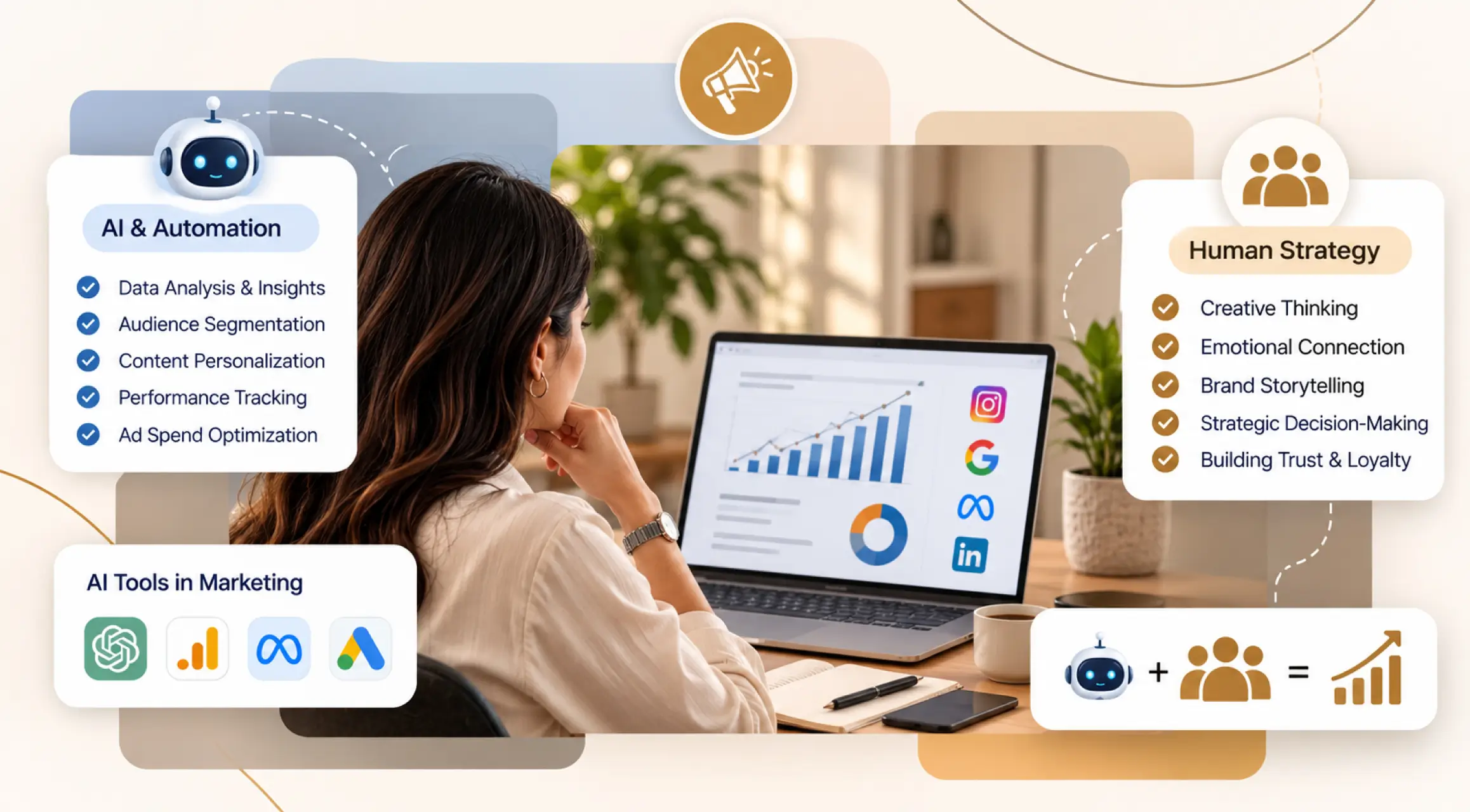
Digital marketing has entered a new phase where technology and creativity work together. Artificial Intelligence (AI) is transforming how businesses understand customers, develop marketing campaigns, create content, and measure results. Activities that once required extensive manual effort can now be completed faster with AI-powered tools and automation.
From analysing search behaviour to optimising advertisements, AI is helping marketers make more informed decisions. However, the growing use of automation also raises an important question: Can technology alone deliver an effective digital marketing strategy?
The answer lies in understanding the difference between completing marketing tasks and building a marketing strategy. AI can process information, recognise patterns, and automate workflows, but successful marketing also requires human judgement, creativity, and an understanding of business objectives.
Let's explore how AI is changing different areas of digital marketing, its limitations, and why the combination of automation and human expertise is becoming increasingly important.
Understanding the Shift Towards AI-Powered Marketing
Traditionally, digital marketing involved several time-consuming activities, including market research, audience analysis, content planning, campaign monitoring, and performance reporting. Marketers had to collect information from different platforms and manually identify opportunities for improvement.
AI has simplified many of these processes.
Modern AI-powered tools can analyse large datasets, identify customer behaviour patterns, generate content suggestions, and assist with campaign optimisation. This allows businesses to understand their audiences and respond to changing market conditions more efficiently.
For example, an e-commerce business can use AI to analyse browsing patterns, identify frequently viewed products, understand customer preferences, and recommend relevant products.
Similarly, a service-based business can analyse website interactions to understand which pages generate enquiries and where potential customers leave the website.
These applications demonstrate how AI can turn marketing data into useful insights.
The Role of Automation Across Different Marketing Channels
AI is not limited to one area of digital marketing. Its applications extend across SEO, social media, paid advertising, content marketing, and customer communication.
Understanding these applications helps businesses identify where automation can improve efficiency.
A. Search Engine Optimisation (SEO)
Search engine optimisation requires continuous research, technical monitoring, content development, and performance analysis.
AI tools can support several SEO activities, such as:
- Identifying relevant keyword opportunities.
- Analysing search intent and related search queries.
- Discovering content gaps.
- Reviewing website structure and technical issues.
- Analysing competitor content.
- Supporting content optimisation.
For businesses investing in search engine optimization services, AI can reduce research time and help identify opportunities that might otherwise go unnoticed.
However, SEO is not simply about finding keywords and placing them throughout a website. Search engines aim to provide users with relevant and helpful information. Therefore, content quality, website experience, technical performance, and topical relevance remain essential.
Human SEO specialists are responsible for interpreting AI-generated insights and converting them into a practical optimisation strategy.
B. Social Media Marketing
Social media platforms generate enormous amounts of engagement data every day. Understanding what audiences respond to can help businesses create more relevant content.
AI can assist with:
- Content topic suggestions.
- Caption and hashtag research.
- Post scheduling.
- Engagement analysis.
- Social listening and brand mention monitoring.
- Identifying content performance patterns.
These capabilities make social media marketing services more efficient by simplifying routine management and providing useful audience insights.
However, social media is fundamentally about communication. A brand cannot build a meaningful community simply by publishing automated posts.
Creative storytelling, relatable messaging, timely conversations, and authentic engagement require human understanding.
C. Performance Marketing and Paid Advertising
Paid advertising requires constant evaluation of campaign performance. Marketers need to monitor impressions, clicks, conversions, cost per acquisition, and return on advertising spend.
AI-powered advertising systems can help automate bidding, optimise ad delivery, identify audience patterns, and test creative variations.
For businesses using performance marketing services, this can improve campaign management and help identify optimisation opportunities more quickly.
Consider a business running multiple advertising campaigns. AI can help identify which campaigns generate stronger conversion signals and where advertising expenditure may need adjustment.
However, a high-performing campaign requires more than automated optimisation. Marketers must establish the right objectives, develop relevant advertisements, understand the customer journey, and evaluate whether the leads generated are valuable to the business.
D. Content Marketing and Website Development
Content is an important part of building brand awareness, educating customers, and generating organic traffic.
AI can support content marketing through:
- Blog topic research.
- Content outlines and first drafts.
- Keyword clustering.
- Content calendar planning.
- Content performance analysis.
- Website copy suggestions.
It can also assist website teams with information architecture, initial copy suggestions, and user-experience research.
However, AI-generated content should never be published without appropriate review. Accuracy, originality, brand voice, practical knowledge, and reader value must remain priorities.
Where AI Has Limitations: The Importance of Human Intelligence
Although AI can perform several marketing activities efficiently, it does not automatically understand the complete context behind every business decision.
Marketing is not just about data. It is also about people, experiences, emotions, and relationships.
Here are some areas where human expertise remains essential.
Understanding Customer Psychology
Customer behaviour is influenced by several factors, including personal preferences, emotions, purchasing power, cultural background, and previous experiences.
AI can identify behavioural patterns, but understanding the reasons behind those behaviours requires interpretation.
For instance, two customers may visit the same product page but have entirely different reasons for not purchasing. One may be comparing prices, while another may need more information before making a decision.
Human marketers can use these insights to develop appropriate messaging and improve the customer journey.
Developing Original Creative Concepts
Marketing campaigns need ideas that distinguish a brand from its competitors.
AI can generate suggestions based on existing patterns, but developing a memorable campaign requires originality, cultural understanding, timing, and creative judgement.
Human creativity helps transform a basic product message into a meaningful brand story.
Maintaining Brand Consistency
Every brand has its own personality, positioning, tone of voice, and communication objectives.
AI-generated content may sound generic if it is not guided by a clear brand strategy.
Human strategists ensure that advertisements, social media communication, website content, and marketing campaigns maintain a consistent identity.
Managing Unexpected Situations
Marketing decisions are not always straightforward. Changes in customer sentiment, market conditions, competitor activity, or business priorities may require immediate adjustments.
AI can provide information, but humans need to evaluate the situation, consider its wider implications, and decide on the appropriate response.
Building Customer Trust
Automation can simplify customer communication through chatbots, automated emails, and instant responses.
However, trust develops through reliable experiences, transparent communication, and meaningful interactions.
Human involvement becomes particularly important when customers have complex questions, specific concerns, or require personalised assistance.
AI and Human Strategy: How They Work Together
Instead of comparing AI and human expertise as separate approaches, businesses should understand how they complement each other.
The following examples demonstrate how responsibilities can be divided.
| Marketing Function | AI and Automation | Human Strategy |
|---|---|---|
| Market Research | Collecting and analysing information | Identifying business opportunities |
| SEO | Keyword research and technical analysis | Search strategy and content quality |
| Social Media | Scheduling and engagement reports | Creative concepts and audience communication |
| Paid Advertising | Bidding and campaign optimisation | Budget planning and campaign direction |
| Content Marketing | Research and draft generation | Storytelling, editing, and originality |
| Email Marketing | Automated workflows and segmentation | Personalised messaging and campaign planning |
| Analytics | Data processing and reporting | Interpreting results and making decisions |
The key is to assign the right responsibilities to the right resources.
AI should help marketers work more efficiently, while human expertise should guide the decisions that influence brand positioning, customer experience, and business growth.
How Businesses Can Integrate AI into Their Marketing Strategy
Adopting AI without a clear objective can lead to unnecessary tool usage and disconnected marketing activities.
Businesses should approach AI integration systematically.
Step 1: Identify Marketing Challenges
Understand which activities consume the most time or require better data analysis. These could include reporting, content research, campaign monitoring, or customer segmentation.
Step 2: Select Relevant AI Tools
Choose tools according to actual business requirements rather than adopting every new technology available.
Step 3: Establish Human Oversight
Ensure that AI-generated information, content, and recommendations are reviewed for accuracy, relevance, and consistency.
Step 4: Connect Automation with Business Objectives
Every automated activity should support a defined goal, such as improving lead quality, increasing website traffic, enhancing customer engagement, or improving campaign efficiency.
Step 5: Measure Performance and Improve
Regularly evaluate whether AI integration is delivering meaningful results. Use performance data alongside human judgement to refine the marketing approach.
Businesses should also consider data privacy, customer consent, intellectual property, and the accuracy of AI-generated information when implementing automation.
The Future of Digital Marketing: More Technology, Greater Need for Strategy
As AI technology advances, digital marketing will become increasingly data-driven and automated. Businesses will have access to more sophisticated tools for audience segmentation, personalised communication, predictive analysis, and campaign optimisation.
However, wider access to technology will also make strategic differentiation more important.
When multiple brands use similar AI tools, the brands that stand out will be those with a clear identity, relevant communication, strong customer understanding, and original creative direction.
Future marketing teams will need to develop a combination of technical knowledge, analytical thinking, creativity, and strategic expertise.
The competitive advantage will not come from using AI alone. It will come from knowing how to use it effectively.
How TYT Studio Approaches the Balance Between AI and Human Strategy
At TYT Studio, we believe that technology should strengthen marketing strategies, not define them entirely.
As an Ahmedabad-based 360° digital marketing agency, we combine AI-powered insights, data analysis, creative thinking, and strategic execution to help businesses build a stronger digital presence.
Our approach focuses on understanding the business before recommending marketing solutions.
Through our integrated services, we help brands:
- Develop structured digital marketing services aligned with their business objectives.
- Improve advertising efficiency through strategic performance marketing services.
- Build stronger online communities with creative social media marketing services.
- Improve organic visibility through comprehensive search engine optimization services.
- Create consistent brand communication through content, branding, and website development.
We use technology to simplify research, analyse performance, and improve marketing workflows. Our team brings the human perspective needed to understand audiences, develop creative concepts, and make informed strategic decisions.
For us, effective digital marketing is a combination of intelligent technology and meaningful human thinking.
Looking to make your marketing more strategic, creative, and performance-focused? Connect with TYT Studio to build a digital marketing approach that moves your business forward.
Final Thought: Technology Can Automate Marketing, but Strategy Creates Impact
AI is making digital marketing faster, smarter, and more efficient, but technology alone cannot build a successful brand. Behind every meaningful campaign is an understanding of people, a clear business objective, and a creative idea that connects with the right audience.
The future of digital marketing is not about choosing between AI and human expertise. It is about bringing them together. When automation handles repetitive tasks and human intelligence guides creativity and decision-making, businesses can create marketing strategies that are not only efficient but also meaningful and result-oriented.
At TYT Studio, we believe in combining AI-powered insights with human creativity and strategic thinking to help brands achieve meaningful digital growth.
Because great marketing isn't just about keeping up with technology; it's about knowing how to use it to create real value.
Frequently Asked Questions
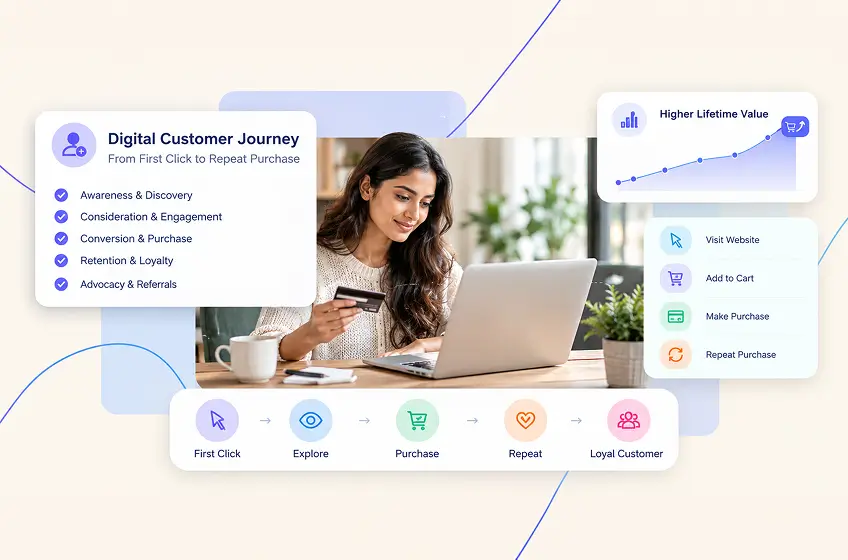
In digital marketing, a customer's decision to purchase is rarely influenced by a single interaction. Before choosing a brand, customers typically go through several stages of online research,...
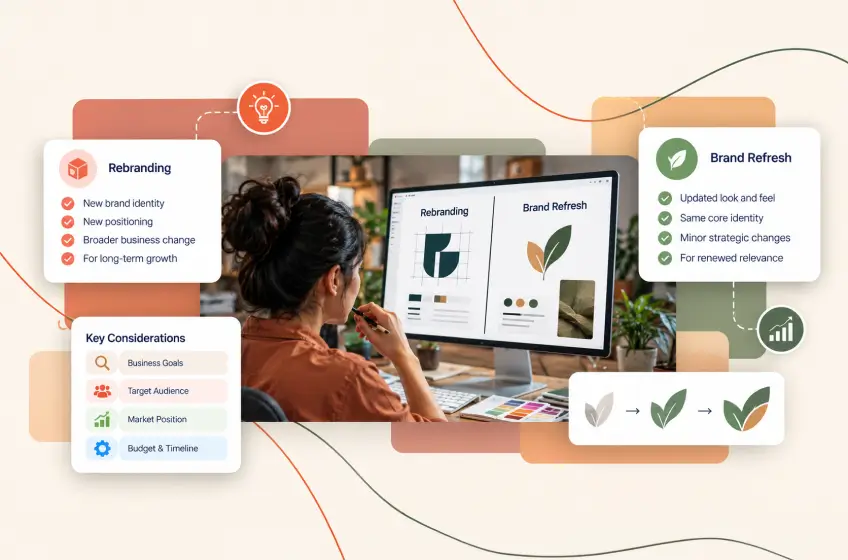
A brand is more than a logo, colour palette, or tagline. It represents how people recognise your business, what they expect from it, and why they choose it over competitors. But as businesses...
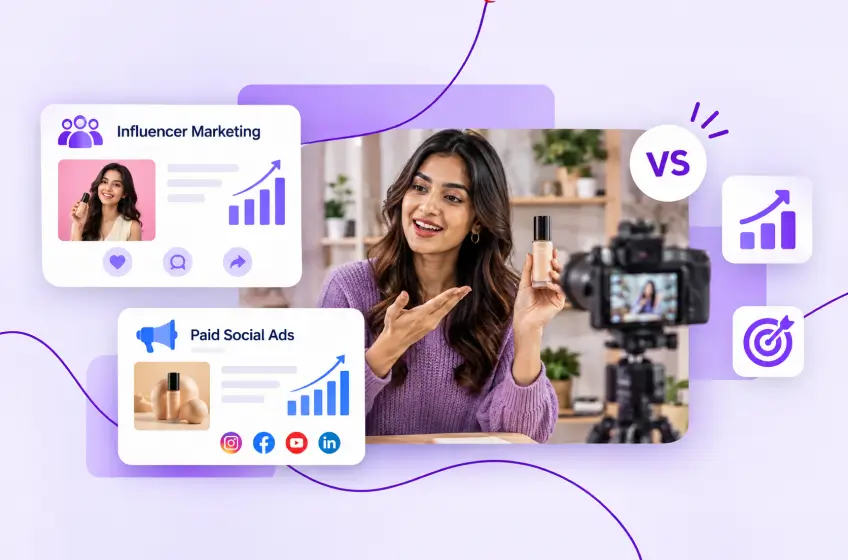
Growing a business on social media takes more than simply posting content or running advertisements. Brands need to build awareness, earn audience trust, and turn interest into meaningful...
Just one more step to make your perfect choice. Book a demo today.


